
Tom Roza on “Ambrose Powell (A.P.) Hill: Third Corps Commander, Army of Northern Virginia”
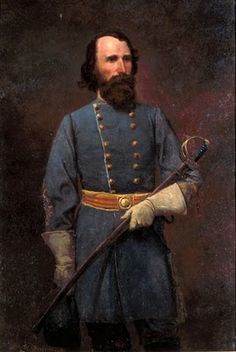 A native Virginian, Ambrose Powell Hill (aka A.P. Hill) was a West Point graduate who served in the United States Army in both the Mexican–American War and Seminole Wars. A strong believer in state’s rights, Powell resigned his US Army commission in March 1861 and offered his services to the fledgling Confederate Army.
After the start of the Civil War, Hill gained early fame as the commander of the “Light Division” in the Seven Days Battles and became one of Stonewall Jackson’s ablest subordinates, distinguishing himself in the 1862 battles of Cedar Mountain, Second Bull Run, Antietam, and Fredericksburg.
In 2014, Tom Roza (current South Bay Civil War Round Table Secretary) presented a general overview on the life and experiences of A.P. Hill. However, during the past four years, Tom has conducted additional extensive research on Hill focusing on his critical role as Third Corps Commander beginning with the Battle of Gettysburg in July 1863 and concluding with his death in April 1865 at Petersburg.
The untimely death of Confederate General Stonewall Jackson at the Battle of Chancellorsville in May 1863 caused General Robert E. Lee to significantly reorganize his Army of Northern Virginia into three Corps. Lee promoted A.P. Hill from his role as a division commander to commander of the newly formed Third Corps. Hill had established an exemplary record as a division commander. But, there is significant evidence that Hill’s leadership skills did not always translate into the more complex role of Corps Commander. Hill often struggled with the logistical, tactical, and most importantly, strategic differences between leading a single 4,000 to 5,000-man infantry division versus an infantry Corps consisting of three divisions of 15,000-18,000 soldiers.
These differences exposed weaknesses in Hill’s leadership that from time to time resulted in an adverse impact on the Confederate Army of Northern Virginia’s chances for success. The presentation effectively details both Hill’s accomplishments and shortcomings during the critically important period of June 1863 to April 1865.
Tom Roza’s primary interest in the Civil War is not centered on the battles, armaments, or politics of that momentous period in our country’s history. Instead, he has focused on a study of the people who were involved in the Civil War—who they were; what was their background; what were their values and principles; and how did they influence the outcome of the Civil War. Civil War personalities that Tom has made presentations on include: John Buford, Jeb Stuart, Winfield Scott Hancock, Robert Gould Shaw, and Nathan Bedford Forrest among others.
Tom is also a published author; his book Windows to the Past: A Virginian’s Experience in the Civil War was published in May 2107 and was accepted by the Library of Congress into its catalog in November 2017. The book is available on Amazon.com in both paperback and eBook formats.