
Monthly Archives: February 2015

Meeting of February 24, 2015

Robert Burch on “The Battle of Big Bethel and the Struggle for Control of the Yorktown Peninsula”, Part 2
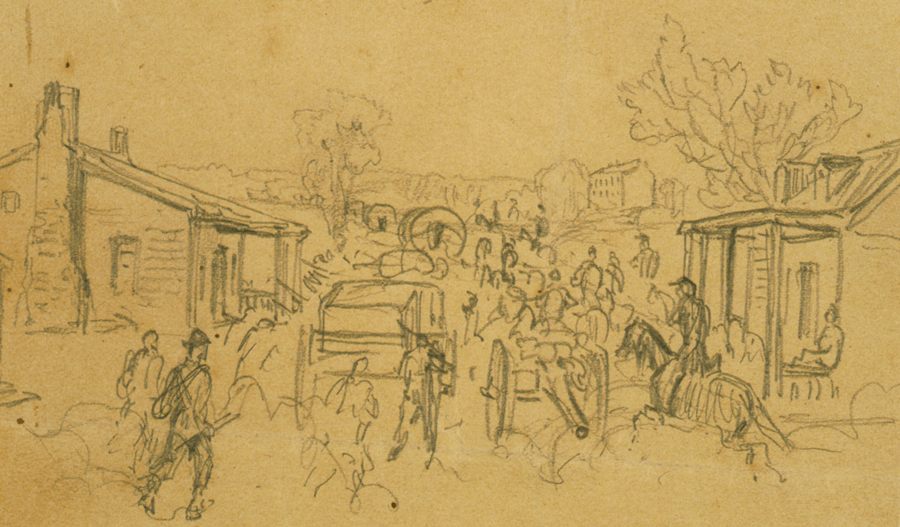
Battle of Big Bethel, sketch by Alfred R. Waud

Battle of Big Bethel, sketch by Alfred R. Waud

Nested between the Siege of Fort Sumter and the Battle of First Bull Run (aka First Manassas) during the spring of 1861 is the often overlooked action at Big Bethel church, Virginia, on June 10th, 1861. Many historians and Civil War enthusiasts consider this action the first true battle of the war. Unfolding political and military events quickly turned Virginia into the first active theater of campaigning for Union and Confederate armies. The Yorktown Peninsula soon became the first contested area within that theater. Conceived by local Union Army leaders as raid to stop Confederate pickets from harassing Union troops, Big Bethel instead became the testing ground for two citizen armies that were mustered, equipped, trained, and deployed over a six-week period following Fort Sumter. Union volunteer regiments attacked Confederates led by John Magruder and Daniel Harvey Hill for three hours. What happened that day and its results were the focus of national attention on both sides until Bull Run six weeks later.

To properly place the action at Big Bethel in perspective, the presentation begins by summarizing the political and military events that led a peaceful nation to war. The political factors that caused thousands of volunteers to fight with passion on June 10th are highlighted. Next the military factors that caused Virginia to become the first active theater of operations and Yorktown Peninsula to host the war’s first battle are surveyed. All participating Union and Confederate regiments and their leaders are concisely portrayed. Finally, the aftermath, analysis and significance of the battle are reviewed. The PowerPoint slides document the product of the speaker’s research in great detail. Time allows only a few key points from each slide to be presented. Numerous period photographs and magazine drawings are included for visual effect with the intent of bringing to life the drama and passion of the war’s first test of arms. Continue reading

Quiz for February 24, 2015

Civil War Quiz: Civil War Cavalry

Q#1 – The flamboyant Confederate cavalry commander of the Army of Northern Virginia went by the name Jeb Stuart. What did the letters J.E.B. stand for?

Q#2 – What was the name of the Union cavalry commander who led a raid through Mississippi during April-May 1863? (Note: The John Wayne movie “Horse Soldiers” was based on this event)

Q#3 – What was the name given to the cavalry brigade that George Armstrong Custer commanded at the Battle of Gettysburg?

Q#4 – What was the nickname given to Confederate cavalry battalion commander John Singleton Mosby?

Q#5 – During the Civil War, what was the main mission of cavalry for both the Union and the Confederates?

Q#6 – What was the nickname Union cavalry troopers gave to Union commander Hugh Judson Kilpatrick?

Q#7 – It is well known that JEB Stuart was killed at the Battle of Yellow Tavern. Who was the Union cavalry commander at that battle?

Q#8 – What is the name of the battle that was the largest predominantly cavalry engagement of the American Civil War, as well as the largest ever to take place on American soil?

Q#9 – What was the name of the Union cavalry commander who repulsed a flanking attack by Confederate Nathan Bedford Forrest that was instrumental in saving the Union Army at the Battle of Franklin in November 1864?

Q#10 – He was nicknamed the “Black Knight of the Confederacy”, commanded Stonewall Jackson’s cavalry forces in the Valley Campaign and was killed in battle in 1862—what was his name?

Q#11 – How was Confederate general and cavalry officer John Hunt Morgan killed?

Q#12 – What was the name of Union cavalry general Philip Sheridan’s horse?

Q#13 – After Jeb Stuart was killed at the Battle of Yellow Tavern, who was named commander of the Confederate cavalry of the Army of Northern Virginia?

Q#14 – John Buford commanded two cavalry brigades on July 1, 1863 at the Battle of Gettysburg. What were the names of the two brigade commanders?

Q#15 – He was considered the tactical master of modern 19th-century mounted forces and wrote a cavalry tactics manual just prior to the Civil War that became the training and fighting textbook for troopers from both sides, and was called “The Father of the United States Cavalry”—what was his name?